


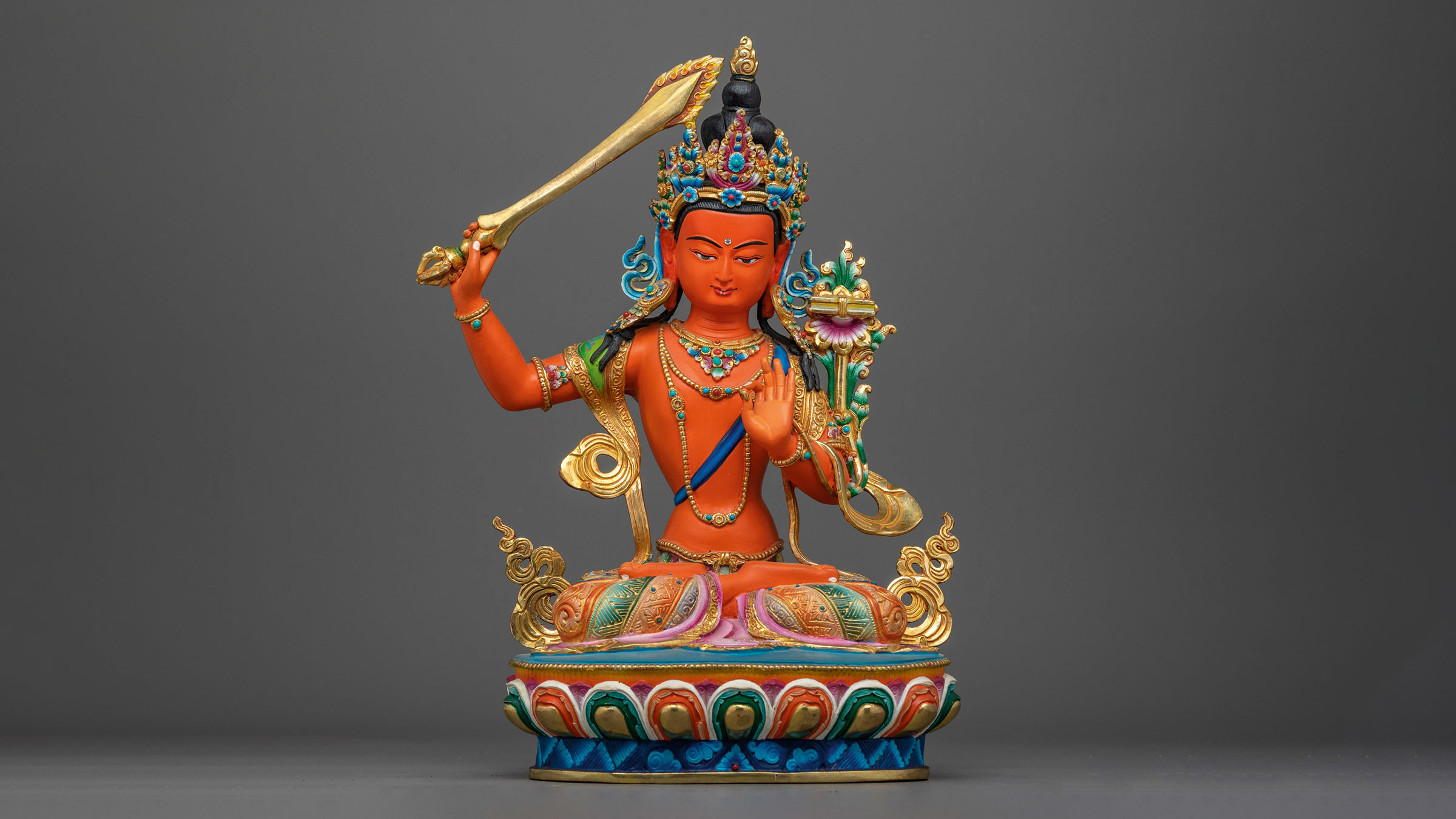
There are days when I feel like I’m drowning in it all – the endless stream of news, the pressure to stay connected, the constant excitement that comes with wanting to be there for people who need care. As someone who lives at the intersection of being black, gay, and Buddhist, the weight of this moment often feels overwhelming. This is why the imagery of Manjushri, the bodhisattva of wisdom, affects me so deeply.
In Buddhist traditions, Manjushri is revered as a bodhisattva; He is dedicated to awakening not only for himself, but for the liberation of all. he incarnates PragyaTranscendent knowledge, the kind of knowledge that opens the door to awakening. Manjushri is often depicted holding a flaming sword in his right hand, symbolizing the wisdom that drives away ignorance, duality and false ideas. In his left hand, he holds a lotus, sometimes with a text or scroll placed on it, representing the perfection of the wisdom teachings. He is also sometimes shown riding a lion, a powerful symbol of fearless wisdom and the fierce roar of truth.
Manjushri’s images illuminate something inside me, not because of the violence we usually associate with swords or weapons, but because of what the sword represents: the power to dispel illusion, the power to face illusion with clarity. And let’s be real – a flaming sword is bad! Right now, we need that kind of energy more than ever.
The noise around us is deafening. Overwhelm pervades our feeds, our conversations, even our inner lives. We are overstimulated, out of control. Many of us are experiencing pain related to our bodies and identity. Combine this with algorithms that amplify outrage, rampant misinformation, and a constant flood of content that makes it difficult to know who or what to trust. The result is exhaustion and confusion, which prevents us from asking deep questions, standing our ground, or seeing what is true.
Manjushri reminds us that knowledge is alive – speaking, teaching, acting, clearing away the fog so we can see things as they are. In a world torn by divisions and steeped in polarization, Manjushree calls us back to clarity and what really matters.
Confusion is everywhere. Artificial intelligence produces convincing lies in a matter of seconds. News cycles spin half-truths for clicks. Entire platforms thrive on misdirection and outrage. We live in an age where information is abundant, but truth seems scarce. The Sword of Manjushri provides another way forward. It invites us to stop and ask: Is it true? Is it useful? What’s beneath all this surface-level noise? Cutting through the BS means rejecting distortion and reclaiming our ability to orient ourselves toward what is real, relatable, and nourishing rather than what happens.
Carrying the sword of Manjushri requires effort and courage. We don’t need to make more frantic efforts or take reactive actions. What is needed is deliberate, courageous and skillful action. Mindfulness is often mislabeled as passive, as if it is merely observing. But Manjushri teaches that clarity demands connection. The sword will have to be raised and swung.
Many of us have been forced to doubt ourselves, second-guess our intuition, shrink or silence our intelligence. Fearlessness with effort reminds us that we have the ability and agency to see clearly and act from that clarity.
But knowledge alone is not enough. Manjushree reminds us that prudence should always be combined with compassion. Our world is changing. Hearts are breaking in the face of injustice, division and change. More people are waking up to the need for care, connection, and original imagination. In this scenario, compassion must be the basis of our clarity.
Wisdom asks: How do I recognize what my energy is worth? Karuna asks: How can I remain steadfast in caring for myself, my people, and my communities while navigating division and noise? Together, wisdom and compassion guide us to act in ways that maintain and repair rather than deepen the cycle of suffering.
When confusion abounds and division is fostered, Manjushri reminds us that clarity requires more than hope – it requires effort, discipline, and deep faith in our own understanding. Wielding the sword of knowledge means recognizing that confusion continues to be dispelled and shared – a practice we all have to do if we want to sustain ourselves and our communities.
Self-Enquiry Questions to Consider
- When drawing the sword of Manjushri in my hands, what confusions or distortions would I first want to eliminate?
- What does fearlessness look like for me in this season – not in theory, but in practice, in relationships and daily choices?
- If clarity is a collective practice, how am I contributing to the space I live in – or obscuring it?
